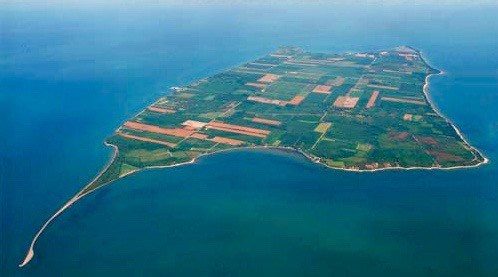
There are thousands of islands in the Great Lakes region. Most of them are uninhabited, but those that are define the term “remote.” Pelee Island, a 16 square mile island in the middle of Lake Erie, is a place that feels, at first, like other small towns in Ontario. When we first started going there we found a hotel, a couple restaurants, a couple stores, and a winery. There were acres of farms and a provincial nature preserve. Gradually, though, you discover an interesting dichotomy between remoteness and connection.
There’s much to be said about the benefits of being separated from the mainland. The provinciality can be a healthy, humane alternative to the metropolis, as noted by Jane Christmas who wrote The Pelee Project: One Woman’s Escape from Urban Madness.
But how remote can you be, really, if you’re not retired with a good retirement account? Unless you’re a farmer or work for the Pelee Island Winery, you have to make money somehow. And tourism is, at best, one of your jobs.
Talking to residents, you get a sense that they like the detachment from the mainland. You might find similar sentiments among anyone living in a remote town, but when you’re surrounded by water, you realize that your connection is timed by the schedule of the ferry or the small commercial airplane. And like most remote towns and villages, internet service has been slow, at best. There is a sense of place and pride of not being connected to the craziness on the mainland. Yet, they are connected and need to be. They need power from the mainland. They need a health clinic and an emergency transportation system. They need a high speed internet — for both the islanders and their seasonal visitors, many of whom are increasingly becoming remote workers.
Recently, the Canadian provincial and federal governments agreed to a $20 million project to connect the island to high speed broadband service. That’s a boon for Pelee. But it’s also another tether to the reality of the world many on the island would rather be disconnected from.
In a sense, islanders want it both ways: the isolation that an island provides, but the connectivity that makes it seem like you never left the digital world. Of course, the digital world in itself celebrates isolation between people who are only miles apart on land. As I observe my weekly designated day disconnected from the internet, I wonder if connectivity will be a good thing for the island. I’m afraid that like the rest of us, Pelee islanders are at risk of succumbing to the digital connectivity that fosters dual realities. In this case, dual remoteness. Just as social media has created a virtual reality — and distance from our other reality — increased access to the internet could exacerbate that, while at the same time reducing the distance that gives an island its allure.
Proponents say that the broadband will enhance sustainability. Irek Kusmierczyk, an Ontario provincial minister said, “For the 300 permanent residents of the island and up to 4,000 seasonal residents, this means they’re unable to participate in our rapidly evolving digital world through employment, education connecting to digital classes, businesses, commerce, and healthcare… Reliable connectivity is not just an internet line and a luxury, it really is a lifeline.”
Yes, it could literally be a lifeline in terms of telemedicine connection. But will it really contribute to sustainability? Sustainability of an island, or any remote place, relies on the ability of human beings to communicate and create bonds built on trust and common good. Community. Pelee Island was known to have a convenience store for islanders, farmers who grew household crops like corn, tomatoes and beans — available at locations where visitors wouldn’t know. And when the tourists go away in the winter and the water occasionally freezes, they are alone, together. Jane Christmas offered a perspective of how the islanders get by as a remote community — and how they relate to an outsider.
Pelee Island, and other residential islands in the Great Lakes, have been isolated in extreme ways by the coronavirus pandemic. Pelee Island will have experienced its second restricted tourist season. A decade ago, the island had a promotion campaign that promoted the relative tranquility — “Peleeisland.calm” — that comes with being distant from the chaos of daily urban life. They valued a slower way of life and greater personal relationships. But they looked for the next boat that ferried visitors to experience their world, dine at their restaurants, and taste the wine at their winery. They relied on support from the Provincial government and a complained when that support was inadequate. The isolation that they cherished came at the cost of government neglect. In reality they needed the power cables that run from the mainland. They needed some form of medical evacuation. In short, they needed to be connected from the place where they sought to be disconnected.
The new broadband connectivity will threaten the remoteness of the island, and threaten it with a different kind of remoteness. Having the internet will connect islanders with the rest of the world; and, they will experience a new kind of remoteness.
Post written by Dennis Archambault
Photo of Pelee Island, Ontario